Judgement
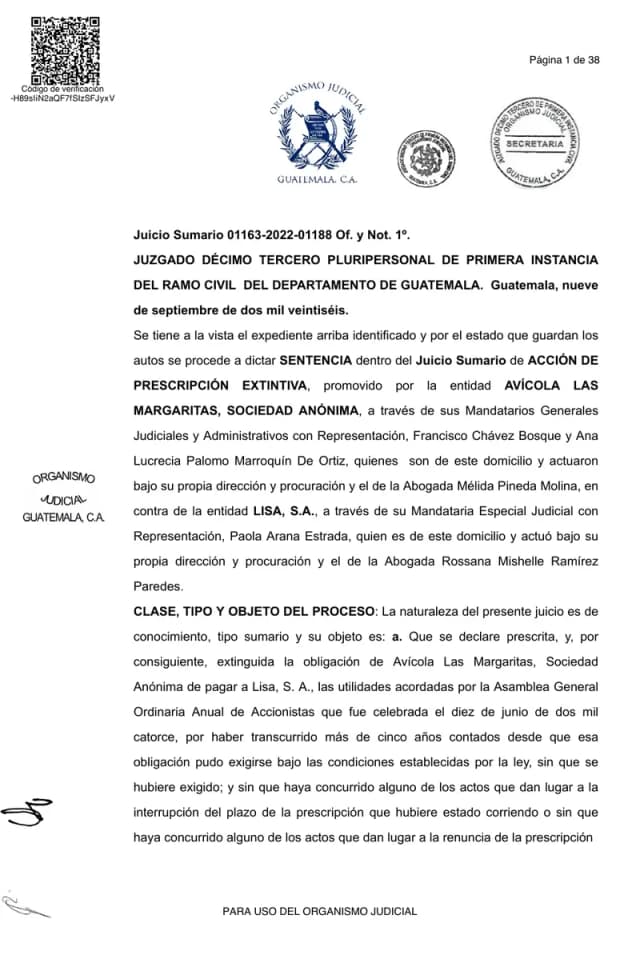
The Thirteenth Civil Court of First Instance rejects the prescription claim of Avícola Las Margaritas, S.A. against Lisa, S.A. and orders the plaintiff to pay costs, because it held the dividends to be attached in other proceedings.
- Issued on
- Sep 9 2026
- Issued by
- 13th Civil Court
- Pages
- 38
On September 9, 2026, the Thirteenth Civil Court of First Instance rejected the claim of Avícola Las Margaritas, S.A. for a declaration that its obligation to pay Lisa, S.A. the profits for fiscal year 2013, whose distribution its shareholders' meeting approved on June 10, 2014, was time-barred ().
The court held that those dividends are subject to precautionary attachments (embargos) ordered in other proceedings, so that neither party has free disposal of them and declaring them time-barred would affect third parties' rights, and that it was not proven that the Board of Directors set and communicated the date and form of payment. It rejected Lisa, S.A.'s negative answer and two of its exceptions, including the one alleging that prescription had been interrupted, and ordered Avícola Las Margaritas, S.A. to pay costs.
Analysis
Case Background
Avícola Las Margaritas, S.A. brought a summary proceeding (juicio sumario) for extinctive prescription (prescripción extintiva) against Lisa, S.A., one of its shareholders, before the Thirteenth Civil Court of First Instance. Lisa, S.A. acted through its attorney-in-fact Paola Arana Estrada, with attorney Rossana Mishelle Ramírez Paredes.
According to the complaint, the plaintiff's annual ordinary general shareholders' meeting of June 10, 2014 resolved to distribute the profits for fiscal year 2013. The plaintiff argued that the obligation, being commercial, was enforceable at once, and that in more than five years none of the acts that interrupt prescription had occurred: no notified lawsuit, no executed precautionary measure, no acknowledgment of the right, no partial payment. It asked the court to declare its obligation to pay those profits to Lisa, S.A., with its accessory obligations, time-barred and extinguished, and to order Lisa, S.A. to pay costs.
Answer and Peremptory Exceptions
Lisa, S.A. filed a negative answer (contestación en sentido negativo, a denial of the claim). It stated that the plaintiff has withheld its dividends since 1999 on the grounds of precautionary attachments (embargos) ordered in damages claims brought against it, and replies to its requests for payment that paying is impossible because of them. It raised five peremptory exceptions (excepciones perentorias, defences on the merits):
- Lack of veracity in the facts said to constitute prescription: nothing proves the dividends were available the day after the meeting, and the articles of incorporation give the Board of Directors the power to set the date and form of payment.
- Absence of the legal prerequisites for prescription: without the Board's notice of the amount, form and date of payment, the obligation is conditional (Article 1592 of the Civil Code) and the period does not run.
- Lack of free disposal of the dividends by both parties: they form part of an attached pool, with the plaintiff's general manager as depositary.
- Infringement of third parties' rights through the precautionary measures constituted earlier over those profits.
- Interruption of prescription by judicial and extrajudicial actions, among them the lawsuits in which its dividends were attached and a demand for payment recorded in a notarial act of October 30, 2019.
Evidence and Its Assessment
The court gave probative value to the notarial act transcribing the resolution to distribute the 2013 profits (Article 186 of the Code of Civil and Commercial Procedure). It denied value to two certificates from the plaintiff's Board of Directors, an accountant's certification and Lisa, S.A.'s economic study, because they concern facts not in dispute, and to the copy of the notarial act of October 30, 2019, which does not specify the periods demanded.
It gave value to the party testimony (declaración de parte, Article 139 of the same code): Lisa, S.A. was declared confesa (deemed to have confessed) by an order of April 23, 2025, after its legal representative failed to appear at the hearing of April 22, 2025, and the plaintiff's attorney-in-fact testified as recorded in minutes of May 28, 2025 (). It also gave value (Article 189) to the report of public accountant and auditor Orlando David Beza Agustín on the inspection of the plaintiff's accounting and commercial books (exhibición de libros) (). For the hearing of August 18, 2025, both parties filed closing arguments, including Lisa, S.A.'s ().
The Court's Analysis
Lack of veracity (rejected). The court held it unnecessary and irrelevant to determine whether the plaintiff had the funds the day after the meeting: the dispute concerns the prescription of Lisa, S.A.'s right to collect, and the availability of the funds is presumed because the meeting expressly approved the distribution.
Legal prerequisites (granted). Companies are governed by their articles of incorporation (Article 15 of the Commercial Code), and the plaintiff acknowledged in its testimony (question two) that its own articles assign to the Board of Directors the power to set the date and form of payment. That power is not discretionary: once the distribution was approved, the Board had to set the time and form of payment, a prerequisite of the right to collect, and, according to the auditor, announce them to the shareholders. It was not proven that the Board determined and communicated those terms to the shareholders, in particular to Lisa, S.A.
Free disposal (granted). From the plaintiff's testimony and the auditor's report on the shareholder register, the court found six annotations of judicial attachments on shares, dividends and profits of Lisa, S.A.: two from 2000, sought by individuals, and four from 2012, sought by Avícola Villalobos, S.A., Compañía Alimenticia de Centroamérica, S.A., Industria Forrajera de Mazatenango, S.A. and Reproductores Avícolas, S.A. It held them to be in force, since the contrary was not proven and the register does not record that they were lifted.
"el embargo es una medida de garantía dictada por autoridad judicial que produce como efecto inmediato la indisponibilidad jurídica de los bienes o fondos afectados, sustrayéndolos de la libre disposición de las partes y colocándolos bajo custodia, guarda o depósito legal." (Page 32)
Lisa, S.A. cannot demand payment, and the plaintiff, as depositary, cannot pay without disobeying a prior court order; it is therefore reasonable that the shareholder did not request it.
Third parties' rights (granted). The attachments were ordered before these dividends were recognized, and declaring prescription would affect the security of the third-party creditors who obtained those attachments in other proceedings and have had no opportunity to assert their rights in this one.
Interruption (rejected). It was not shown that the proceedings Lisa, S.A. invoked concern the same profits and period: an interrupting act must relate to the same right and be served on the defendant, or the precautionary measures at least executed (Article 1506 of the Civil Code). The extrajudicial demand of 2019 is not a ground provided in that article, nor does it specify the periods demanded.
The claim (rejected). The court held the negative answer insufficient to be upheld, but found that the analysis of the claim leads to a different conclusion. Even if it could be established that the period under Article 1508 of the Civil Code had been exceeded without interruption, the 2013 dividends are under precautionary attachment in other proceedings. Declaring them time-barred would mean recognizing the extinction of Lisa, S.A.'s property right on which the attachments rest (Articles 38 and 105 of the Commercial Code), at the risk of nullifying the effects of the orders that imposed them and of impairing the rights of third parties who took no part in this proceeding.
"Ello comprometería los principios de seguridad jurídica, certeza de las decisiones judiciales y tutela del derecho de defensa. Por tales razones, la demanda debe declararse sin lugar." (Page 37)
Under Article 573 of the Code of Civil and Commercial Procedure, it ordered the losing party to pay costs.
Ruling
- I. The summary claim for extinctive prescription brought by Avícola Las Margaritas, S.A. against Lisa, S.A. is rejected.
- II. The negative answer and the peremptory exceptions of lack of veracity and of interruption of prescription by judicial and extrajudicial actions are rejected.
- III. The peremptory exceptions of absence of the legal prerequisites for prescription, lack of free disposal of the dividends by both parties, and infringement of third parties' rights through previously constituted precautionary measures are granted.
- IV. Avícola Las Margaritas, S.A. is ordered to pay costs.
- V. Let the parties be notified.
Legal Basis
- Articles 1501 and 1508 of the Civil Code: extinctive prescription extinguishes an obligation five years after it became enforceable; that period alone does not suffice where the dividends are attached.
- Article 1506 of the Civil Code: the grounds that interrupt prescription; the interruption Lisa, S.A. alleged was not held proven.
- Article 15 of the Commercial Code: a company is governed by its articles of incorporation, from which arises the Board of Directors' duty to set and communicate the date and form of payment.
- Articles 38 and 105 of the Commercial Code: the shareholder's property right on which the attachments rest, including the right to share in profits.
- Article 573 of the Code of Civil and Commercial Procedure: costs against the losing party.
Documents
5| Document | Date |
|---|---|
| May 28 2025 | |
| Jun 6 2025 | |
| Aug 18 2025 | |
| Sep 8 2025 | |
| Sep 9 2026 |