Motion
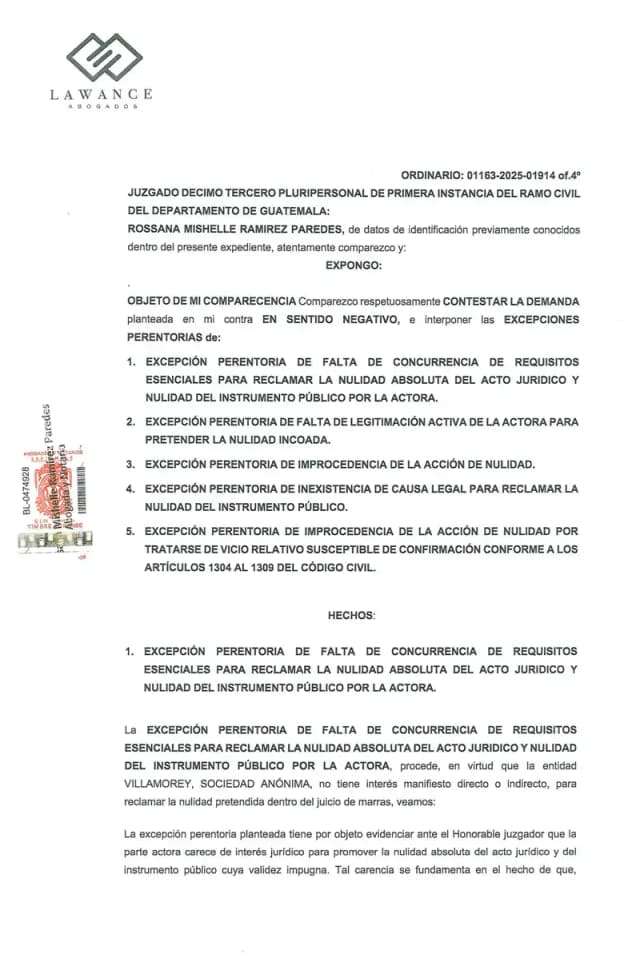
Rossana Mishelle Ramírez Paredes files a negative answer to Villamorey's nullity suit against the protocolization of Panama's Order 898, raising five peremptory exceptions.
- Issued on
- Nov 5 2025
- Issued by
- Lisa, S.A.
- Pages
- 12
Rossana Mishelle Ramírez Paredes, the notary sued by Villamorey, S.A. in an ordinary action for absolute nullity of a juridical act and public instrument (Case No. 01163-2025-01914), answers the complaint in the negative and raises five peremptory exceptions. The answer argues that Villamorey lacks standing and manifest interest under Article 1302 of the Civil Code, that the protocolization of , issued by Panama's Twelfth Circuit Civil Court, was performed in accordance with Article 39 of the Judiciary Act and Article 63, paragraph one, of the Notarial Code, and that, subsidiarily, any defect would constitute a relative nullity susceptible to confirmation. The answer was filed the same day the Fifth Chamber, in , affirmed the dismissal of the extinctive prescription action in the related proceeding.
Analysis
Background
Villamorey filed this nullity action against the protocolization of issued by Panama's Twelfth Circuit Civil Court, which approved a judicial transaction between Lisa, S.A. and BDT Investments, Inc. Notary Ramírez Paredes protocolized the order through Protocolization Act number three, authorized on January 22, 2024. Villamorey alleges the protocolization was performed without a request from an interested party, in violation of Articles 63 and 64 of the Notarial Code and Article 39 of the Judiciary Act, and therefore suffers from absolute nullity.
The protocolized instrument was used by BDT Investments, Inc. to request participation as a third-party co-adjuvant in the ordinary action for extinctive prescription () filed by Villamorey against Lisa. The Eighth Multi-Judge First Instance Civil Court denied that request, finding that BDT had not established a legal nexus or procedural interest in the outcome of the case. Villamorey now seeks to nullify the instrument that supported a request already denied by the court.
Peremptory Exceptions
Lack of essential requirements for nullity. The answer argues that Villamorey has no manifest, direct, or indirect interest in claiming the nullity sought. Under Article 1302 of the Civil Code, only those with a direct, current, and legally protected interest may allege nullity. The challenged instrument produced no effect on Villamorey's sphere of rights: BDT's request was denied, the Panamanian transaction was not recognized in the Guatemalan proceeding, and the protocolization neither created, modified, nor extinguished any right of the plaintiff.
Lack of active standing. Villamorey was not a party to the judicial transaction approved in Panama nor to the protocolization. The answer invokes Articles 49 and 51 of the Code of Civil and Commercial Procedure, which require that anyone bringing an action do so in defense of a personal right and with legitimate interest. With no nexus between Villamorey and the challenged act, the plaintiff lacks the legal capacity to pursue the nullity.
Improcedence of the nullity action. The answer contends that the protocolization act does not constitute a juridical act susceptible to nullity, but rather a notarial act of documentary verification and conservation. The protocolization was performed under Article 63, paragraph one, of the Notarial Code, which authorizes notaries to protocolize judicial documents "by and before themselves" without requiring any party's request, and under Article 39 of the Judiciary Act, which permits the optional protocolization of judicial or administrative documents. The instrument creates no rights or obligations; its function is exclusively one of fe pública, custody, and conservation of a foreign judicial document.
No legal cause for nullity. The answer refutes Villamorey's interpretation of the term "interested party" in Article 39 of the Judiciary Act. It argues that the term does not require the physical appearance of a private individual, but identifies the holder of the interest that may motivate the protocolization. Article 64 of the Notarial Code confirms this reading by requiring the names and signatures of applicants only "as applicable" ("en su caso"), a conditional expression recognizing that applicant involvement is not necessary when dealing with public documents. The answer highlights that if Villamorey's interpretation were adopted, the "interested party" required to request the protocolization of a judicial order would be the judge who issued it, a result characterized as juridically absurd.
"Si se adoptara la tesis de la actora, habría que concluir que en los casos de documentos judiciales el 'interesado' obligado a requerir la protocolización sería el propio juez que dictó la resolución, pues es él quien emite el documento público." (Page 7)
Relative nullity susceptible to confirmation. As a subsidiary argument, the answer contends that even hypothetically accepting the existence of a defect, it would constitute relative nullity rather than absolute nullity, under Articles 1304 through 1309 of the Civil Code. Relative nullity is susceptible to express or tacit confirmation, and Article 1308 establishes the principle of separability: nullity of the protocolization (an accessory act) would not affect the validity of the underlying Panamanian judicial transaction (the principal act).
Evidence Offered
The answer offers a simple photocopy of the March 21, 2024 resolution from the Eighth Multi-Judge First Instance Civil Court, which denied BDT Investments, Inc.'s request to participate as a third-party co-adjuvant in . It also offers a certification from the General Protocols Archive of Protocolization Act number three. Additionally, it reserves the specification of official reports, document exhibition, Villamorey's party declaration, and confession without interrogatories.
Legal Basis
- Article 1302 of the Civil Code — limits standing to allege nullity to those with manifest interest; foundation for the standing and interest exceptions
- Articles 49 and 51 of the Code of Civil and Commercial Procedure — require personal interest and standing to bring judicial actions
- Article 39 of the Judiciary Act — authorizes optional protocolization of judicial or administrative documents
- Article 63, paragraph one, of the Notarial Code — empowers the notary to protocolize judicial documents "by and before themselves" without requiring any party's request
- Article 64 of the Notarial Code — requires names and signatures of applicants only "as applicable," recognizing this is not a universal requirement
- Article 28 of the Notarial Code — grants public instruments the force of proof for facts witnessed by the notary
- Articles 1304 through 1309 of the Civil Code — govern confirmation and revalidation of voidable juridical acts
- Article 118 of the Code of Civil and Commercial Procedure — governs the answer to the complaint and the filing of peremptory exceptions
Relief Sought
- Accept the answer in the negative and the five peremptory exceptions as filed
- Admit the evidence offered and the accompanying documents into the record
- Open a thirty-day evidentiary period
- Schedule the hearing date
- Dismiss the ordinary action for absolute nullity of the juridical act and public instrument filed by Villamorey, S.A.
- Grant all five peremptory exceptions
- Order Villamorey, S.A. to pay costs
Signatories
- Rossana Mishelle Ramírez Paredes, Attorney and Notary (acting in her own legal counsel)
Documents
5| Document | Date |
|---|---|
| Mar 7 2025 | |
| Jul 11 2025 | |
| Oct 17 2025 | |
| Nov 5 2025 | |
| Nov 5 2025 |